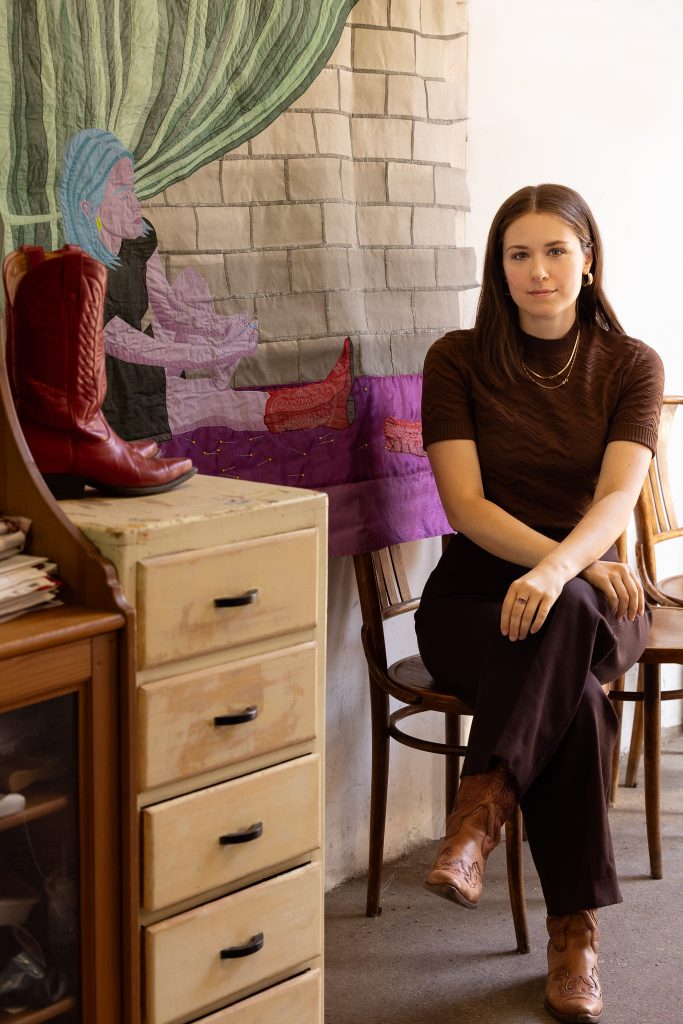
En un momento sociohistórico en el que el mundo se erige bajo la denominación del ente digital, el trabajo de Lauren Januhowski (Houston, Texas, 1992) reivindica el valor de lo táctil, lo lento y lo íntimo. A través del textil, la artista narra relatos que conectan memoria, corporalidad y emoción, explorando los vínculos entre generaciones de mujeres y las formas laberintícas en que cohabitamos lo cotidiano. Con motivo de su próxima exposición en la madrileña Marquesa Gallery, conversamos con ella sobre proceso, materialidad y lenguaje silencioso que se transmite a través de las manos.
sirocomag: ¿Qué te ofrece el textil como medio que lo diferencia de otros lenguajes artísticos?
Lauren Januhowski: El textil es un medio que me permite conectar con mi pasado, mi presente y mi futuro al mismo tiempo. Aprendí a coser de mi madre, ella de mi abuela, y así sucesivamente. Ninguna tuvo una formación académica en costura, así que cuando creo siento que participo en un lenguaje compartido e intuitivo que pasa de unas manos a otras.
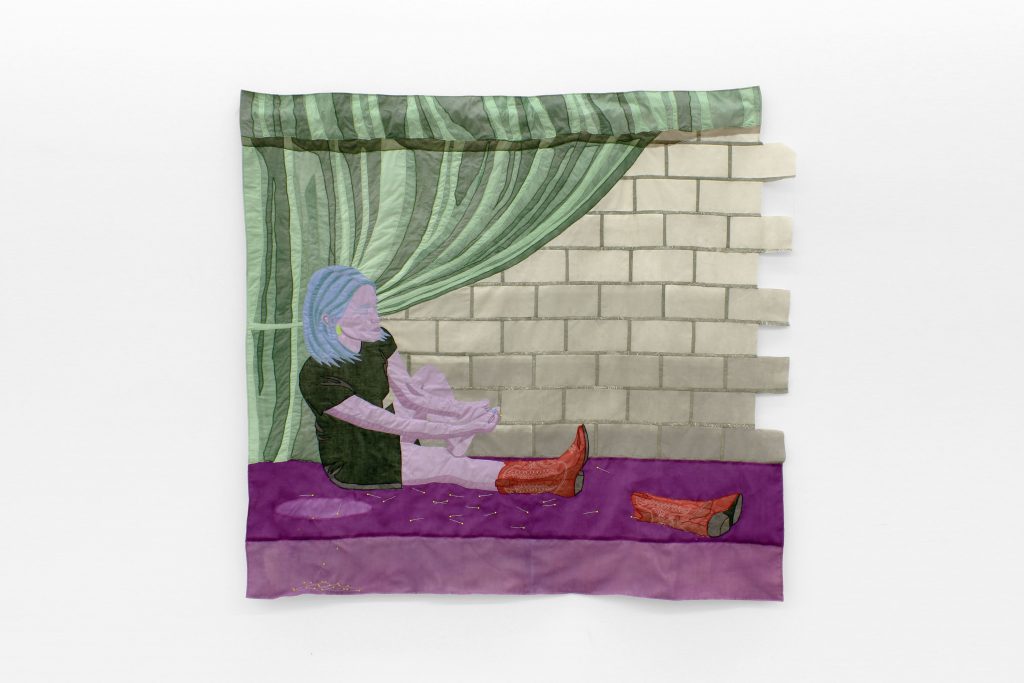
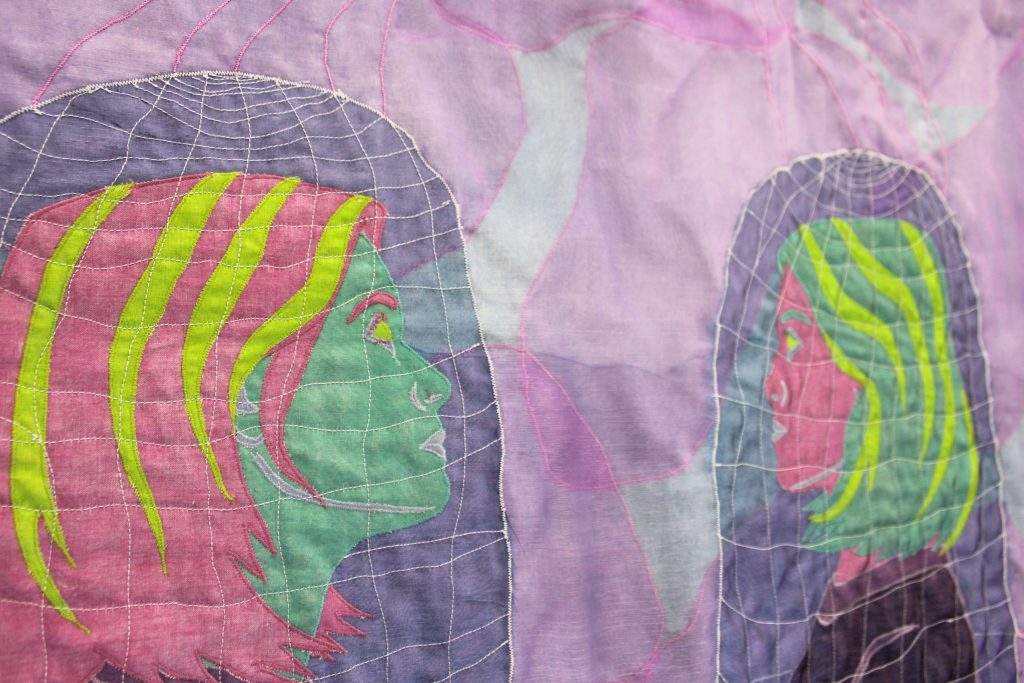
Mientras las texturas y los colores me anclan al presente, el proceso de estampar mis propios tejidos y construir el volumen físico de las piezas me permite proyectarme hacia el futuro. Dibujar figuras mediante cortes y superposiciones, en lugar de con un lápiz, me produce una gran sensación de libertad. Las técnicas textiles liberan mi energía creativa y mis inhibiciones de una forma que la superficie plana del dibujo o la pintura no consigue; el propio material se convierte en un colaborador dentro de la obra.
S.M.: En los últimos años hemos visto un resurgir de las prácticas textiles. En esta sociedad “líquida”, ¿a qué crees que responde este renovado interés?
L.J.: Creo que este resurgir del textil responde directamente a la falta de fricción en nuestras vidas contemporáneas. Hoy en día, muchas de nuestras experiencias son efímeras, superficiales y digitales. Como sociedad, nos hemos desplazado rápidamente hacia un modelo en el que el hogar se ha convertido en el principal espacio tanto de trabajo como de descanso, algo con lo que quienes trabajamos en lo textil llevamos tiempo dialogando.
Cuando nuestra vida cotidiana pasa por pantallas planas, surge de forma natural el deseo de volver a lo táctil y a lo lento. Las prácticas textiles ofrecen un anclaje sólido dentro de este mundo líquido: exigen ritmos físicos y una atención mental que lo digital no puede reproducir. A través de ellas no solo producimos objetos, sino que recuperamos nuestro tiempo y nos reconectamos con los espacios tangibles que habitamos.
S.M.: Tu obra bebe de la historia, las emociones, las mujeres que te rodean y los sueños. ¿Podrías contarnos más sobre tu proceso creativo y tus referencias textiles?
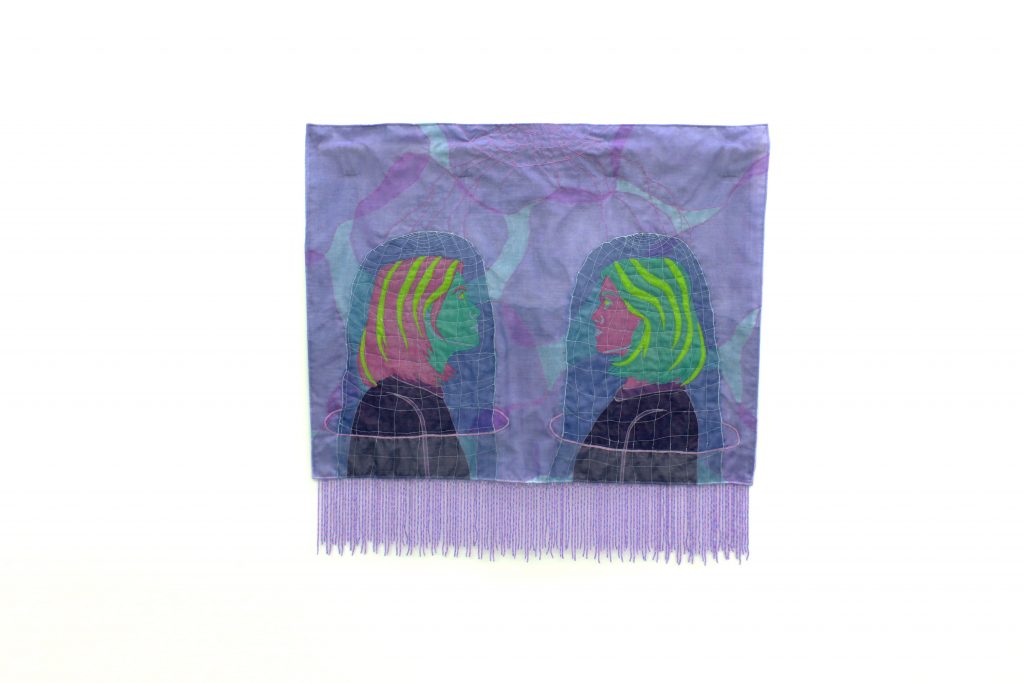
L.J.: Mi trabajo se inspira en las formas complejas en que las mujeres se relacionan entre sí y con el mundo. Recurro a fuentes muy diversas: recuerdos personales transformados en escenas imaginadas, ciencia ficción feminista de corte distópico, iconografía medieval o la artificialidad de los decorados cinematográficos y teatrales.
Mi proceso se desarrolla como un diálogo entre lo digital y lo manual. Empieza con un collage de imágenes, propias o encontradas, que amplío hasta convertirlas en un “patrón” físico que funciona como guía estructural. La imagen y las telas que estampo a mano evolucionan a la vez; los colores surgen por su carga emocional o de observaciones fugaces del día a día. Ambos elementos —la idea y el material— terminan encontrándose y fusionándose en una única obra.
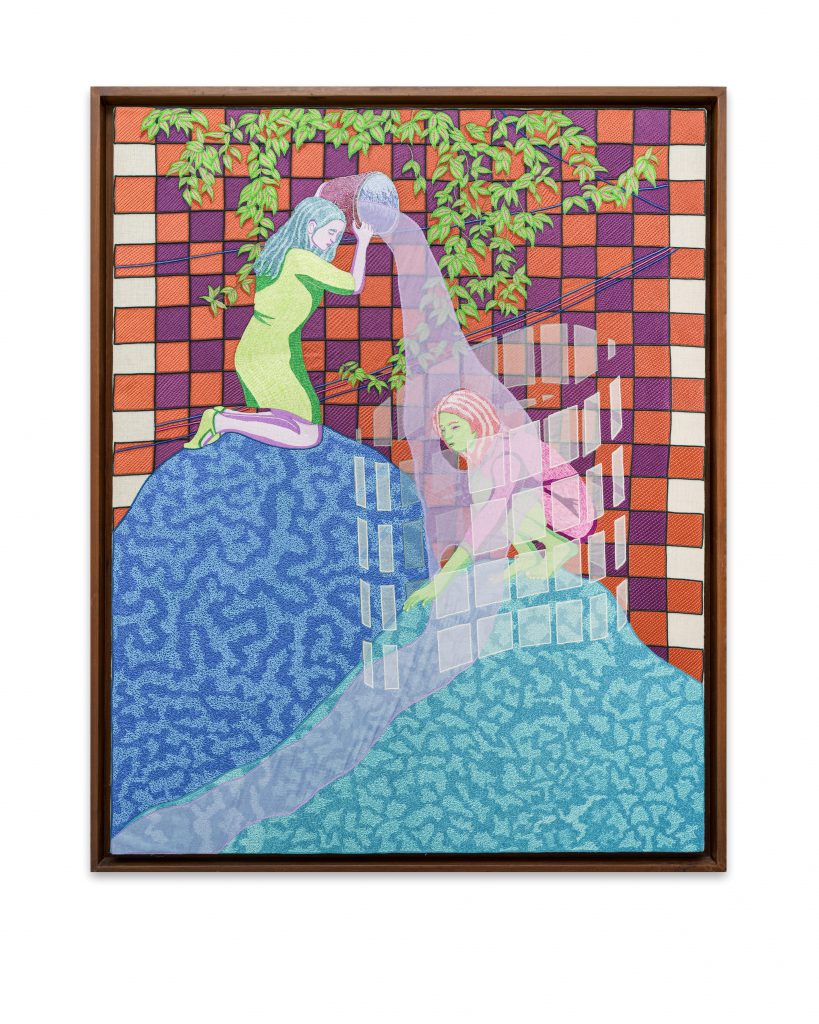
Debido a la cantidad de capas que intervienen —collage, estampación, ensamblaje y un trabajo minucioso de abalorios—, cada pieza es un ejercicio de presencia prolongada que suele llevar al menos un mes. Encuentro una gran inspiración en artistas como Erin M. Riley, Hangama Amiri o Diedrick Brackens, cuya maestría técnica convierte relatos íntimos en experiencias compartidas con el espectador, generando una cercanía que yo también intento cultivar en mi trabajo.
S.M.: ¿Cómo dialoga tu próxima exposición en Marquesa Gallery con tu trayectoria anterior y qué nuevas líneas de investigación o cambios plantea?
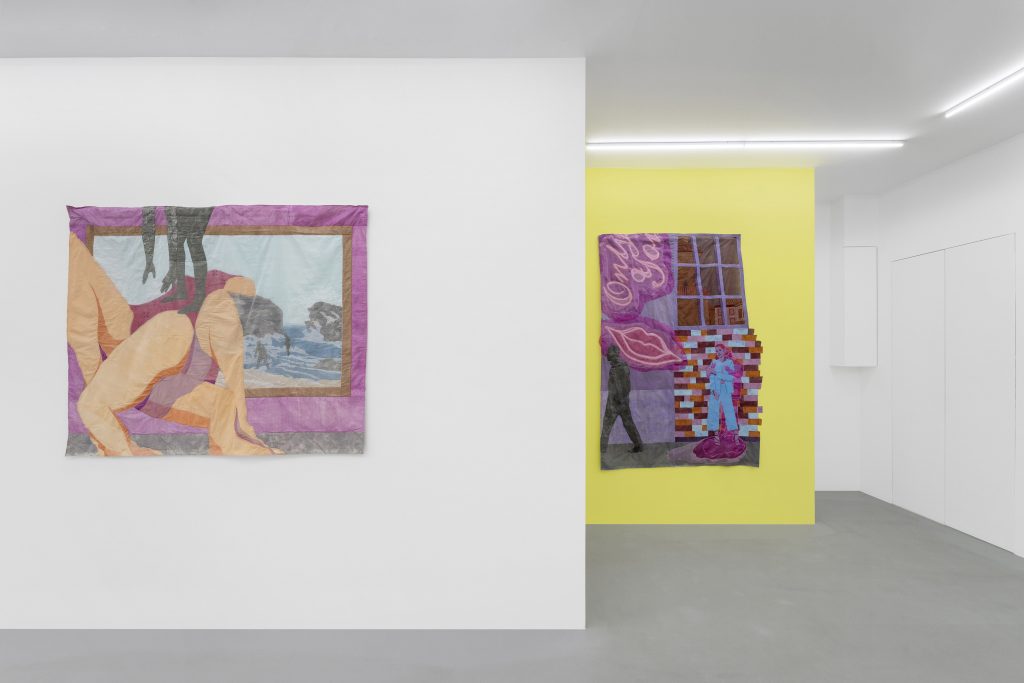
L.J.: Mi próxima exposición en Marquesa Gallery, What We Invoke / Lo que invocamos, supone un hito importante: reúne cinco años de trabajo y es mi primera presentación ante el público español. Con ella quiero guiar al espectador a través de los hilos comunes que han definido mi práctica: el descubrimiento de lo ritual en la vida cotidiana de las mujeres, nuestras conexiones espirituales con paisajes cercanos y lejanos, y las formas íntimas en que procesamos las emociones, tanto en soledad como en comunidad.
Al preparar esta muestra, no he planteado las obras nuevas como una ruptura, sino como un puente. He vuelto a paisajes mentales y emocionales anteriores para permitir que distintas series dialoguen entre sí dentro de un mismo espacio. Si hay un cambio claro, es más bien físico: estoy empezando a investigar cómo sacar el textil de la pared y llevarlo al centro del espacio expositivo. Al invitar al espectador a rodear las piezas, exploro el textil como presencia tridimensional, transformando la tela de superficie en entorno.
ENGLISH VERSION
sirocomag: What does the textile medium offer you that differentiates it from other artistic languages?
Lauren Januhowski: Textile is a medium that allows me to connect with my past, present, and future simultaneously: I learned how to sew from my mom, who learned from my grandmother, who learned from her mother before her. None of us ever had formal sewing education, so when I create, I feel that I am participating in the shared, intuitive language of our hands.
While textures and colors keep me grounded in the present, the process of printing my own swatches and building up the physical thickness of a piece allows me to project myself into the future. By “drawing” figures through cutting and layering rather than using a pen, I experience a sense of liberation. Textile techniques release my creative energy and inhibitions in a way that the flat surface of a drawing or painting never could; the material itself becomes a collaborator in the work.
S.M.: In recent years, we have witnessed a resurgence of textile practices. In today’s “liquid” society, what do you think has prompted this renewed interest?
L.H.: I believe that this resurgence of textiles and the growing interest in their practice is a direct response to the lack of friction in our modern lives. Today, our experiences are increasingly trivial, fleeting, and digital. As a society, we have rapidly shifted into a lifestyle in which the home has become the primary site of both production and rest—something that we, as textile artists, have been engaging with for quite some time.
When our daily lives are filtered through flat glass screens, there is a natural desire to return to actions that are tactile and slow. Textile practices offer a “solid” anchor in our liquid world; they require physical rhythms and a mental presence that digital platforms cannot replicate. Through these textile techniques, we are not merely producing objects—we are reclaiming our time and grounding ourselves in the tangible spaces we inhabit.
S.M.: Your work draws from history, emotions, the women around you, and dreams. Could you share more about your creative process and your main textile references?
L.H.: My work is inspired by the complex ways women relate to one another and to the world. I draw from a wide range of sources: personal memories transformed into imagined scenes, feminist dystopian science fiction, medieval iconography, and the artifice of film and theater sets.
My process unfolds as a dialogue between the digital and the tactile. It begins with a collage of found or original photographs, which I enlarge into a physical “pattern” that serves as an architectural guide. The imagery and the hand-printed fabric swatches evolve simultaneously; the colors are chosen for their emotional connotations or drawn from fleeting observations of daily life. These two elements—the vision and the material—eventually converge and fuse into a single work.
Because of the many layers involved—collaging, printing, assembly, and intricate beadwork—each piece becomes a marathon of presence, often taking at least a month to complete, and I find deep inspiration in the work of Erin M. Riley, Hangama Amiri, and Diedrick Brackens, whose technical mastery transforms intimate, personal narratives into a sense of shared closeness with the viewer—a quality of invitation that I strive to cultivate in my own practice.
S.M.: How does your upcoming exhibition at Marquesa Gallery enter into dialogue with your previous trajectory, and what new lines of inquiry or conceptual shifts does it propose within your practice?
L.H.: My upcoming exhibition at Marquesa Gallery, What We Invoke / Lo que invocamos, marks a significant milestone as the culmination of five years of work and my debut before the Spanish public. With this presentation, I aim to guide viewers through the common threads that have defined my practice: the discovery of ritual within our daily lives as women, our spiritual connections to both familiar and foreign landscapes, and the intimate ways we process emotion—both in solitude and within our communities.
In preparing this exhibition, I approached the newer works not as a departure but as a bridge, revisiting earlier mental and emotional landscapes and allowing different series to finally converse within the same space. If there is a defining conceptual shift in this show, however, it is a physical one: I am beginning an investigation that draws my textile pieces away from the safety of the wall and into the center of the exhibition space. By inviting viewers to move around the work rather than simply stand before it, I explore textiles as a three-dimensional presence, transforming fabric from a surface into an environment.